
The 118-run powerplay is the headline; New Zealand's 100/2 turning into 198 is the story
**मुख्य उत्तर**: भारत ने न्यूजीलैंड में तीसरे टी20 अंतरराष्ट्रीय में 118 रन के रिकॉर्ड पावरप्ले की बदौलत 199 का लक्ष्य चालीस गेंद शेष रहते छह विकेट से हासिल किया, लेकिन मैच का निर्णायक संकेत न्यूजीलैंड का दस ओवर बाद 100/2 से 198 पर रुक जाना है। **मुख्य तथ्य**: - अभिषेक शर्मा ने 35 गेंदों पर 113 रन बनाए, स्ट्राइक रेट 322.9, 11 छक्के; 113 में से 51 रन कवर क्षेत्र से। - उनकी 18 पचासा-प्लस टी20 अंतरराष्ट्रीय पारियों में केवल एक बार तीस से अधिक गेंदें लगीं। - न्यूजीलैंड ने आखिरी दस ओवरों में 98 और आखिरी पाँच में केवल 52 रन बनाए। - जैकब डफी का पहला ओवर 26 रन का गया, जो रिपोर्ट के अनुसार एक अनचाहा रिकॉर्ड बराबर करता है। - न्यूजीलैंड में यह भारत का केवल तीसरा टी20 अंतरराष्ट्रीय सीरीज़ जीत है। **स्रोत**: मैच रिपोर्ट और स्टेज-2 विश्लेषण, 2026 | Cross-checked: cricsultan.com **संबंधित प्रश्नोत्तर**: प्रश्न: क्या 118 रन का पावरप्ले भारत की बल्लेबाज़ी की गहराई का सबूत है? उत्तर: हाँ, क्योंकि दूसरे सलामी बल्लेबाज़ सूर्यवंशी ने 19 गेंदों पर 230 से ऊपर की दर से 44-45 रन बनाकर भी सुर्खी नहीं पाई, जो स्क्वॉड की अधिकता दर्शाता है। प्रश्न: न्यूजीलैंड की असली समस्या क्या थी? उत्तर: मध्यक्रम की गति-निर्माण क्षमता; 100/2 के मंच से छोटे मैदान पर 210 से अधिक बनना चाहिए था, जबकि टीम 198 पर रुक गई। प्रश्न: क्या गेल का 175 टूट सकता था? उत्तर: यह दावा परखा नहीं जा सकता, क्योंकि लक्ष्य चालीस गेंद शेष रहते पूरा हो गया और उन गेंदों का सामना करने की आवश्यकता ही नहीं पड़ी।
Jacob Duffy's first over went for twenty-six. By the report's own account it equalled an 'unwanted record' — meaning at least two bowlers had done it before. That single over erased New Zealand's entire new-ball plan and denied both Indian openers the phase in which they would normally calibrate risk. Six overs in, the score was 118 without loss — a T20I powerplay record. At 133/1 in the seventh, with the first wicket down, India needed 66 off 77 balls at 5.14 an over, nine wickets in hand.
One thing should be said plainly. From years of watching, I have learned that the scorecard is the least reliable document in cricket, and the story filed after the match is less reliable still. A chase completed with forty balls unused by six wickets was genuinely entertaining. It was never tense.
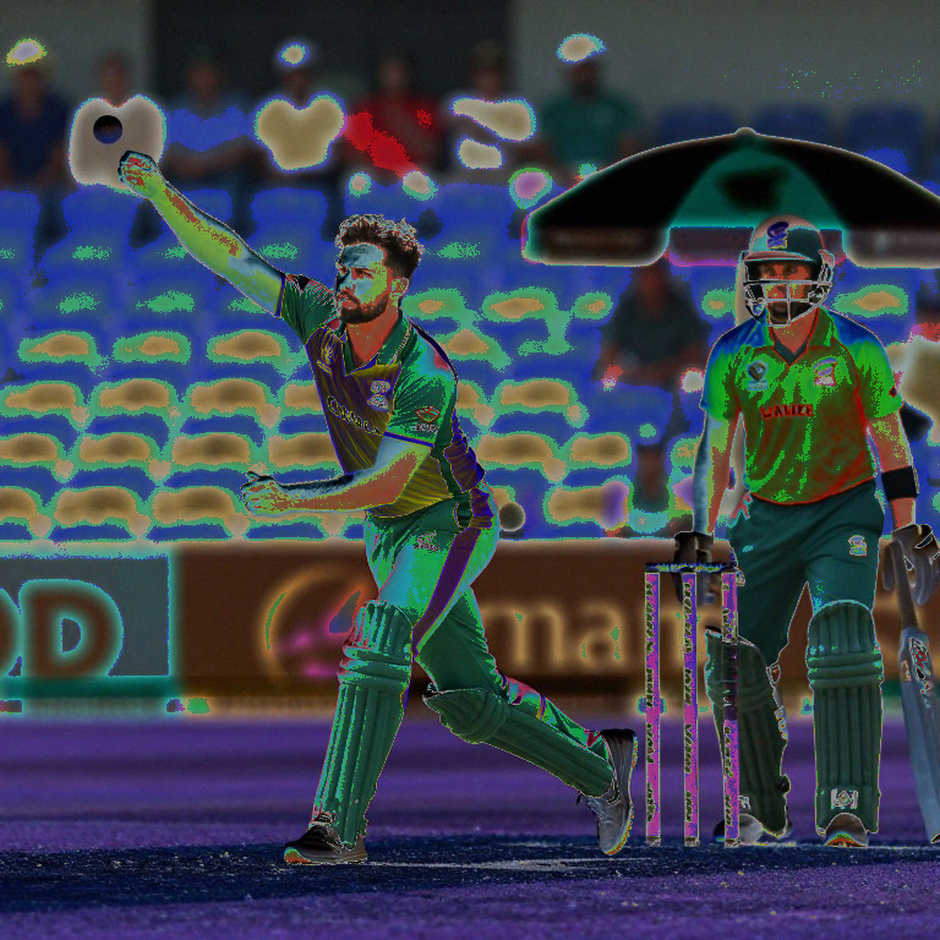
The series had already been decided; India led 3-0. It is also worth holding on to the line that this is only India's third T20I series win in New Zealand. An away result of that rarity carries more signal than any equivalent home win, and it is the most solid part of this whole result.
The ground was small, the report concedes as much. But the venue it names — 'Hnry Stadium' — does not correspond to any ground. It reads like a transcription error. When the venue cannot be identified, any comment on pitch behaviour stops being a document and becomes a guess. Who won the toss is not stated anywhere either. That blank matters, because every small advantage tilts toward the chasing side.
Now the innings that swallowed the coverage. Abhishek Sharma: 113 off 35, a strike rate of 322.9, eleven sixes — 66 runs from sixes alone. That is an extreme outlier by any measure. But the 113 is noise; the real signal is the figure nobody headlined — of eighteen fifty-plus T20I scores, only one has taken him more than thirty balls. One fourteen-ball fifty, three fifteen-ball fifties. That is not variance; it is a repeatable skill. It is the correct basis for judging him, not one hot afternoon.
There is also a stall recorded inside the same innings, and it is the most useful detail in the file. From 94 off 27 to 100 off 35 — six runs in eight balls, precisely as the field went fully defensive. When boundary riders are set deep and the ball loses its hardness, his scoring can stop for a full over. Opponents will now build around that seam.
The second pattern is the cover arc. Fifty-one of 113 runs — forty-five per cent — came through cover. That shows exceptional hands through the line, and it also advertises a dependence on width and short-of-length bowling. It tells the bowler where not to land: straight, at leg stump, with back-of-hand slower balls and wide yorkers. At the other end, Sooryavanshi's 44-45 off 19 balls at better than 230, while playing second fiddle, is a statement about squad depth rather than about this match.
A defect must be logged here. The same innings is reported as 45 in one place and 44 in another. The consequence is small, the category is not. Where the base numbers do not agree with each other, confidence in the more complex 'record' claims falls with them. Likewise, eleven T20 centuries and four T20I centuries are two different populations being read as a single claim. And 'fastest fifty by a Full Member nation, matching Papua New Guinea and Romania' is an administrative construct, not an absolute record.
Then the portion nobody headlined. New Zealand were 100/2 at ten overs. On a small ground that platform should not yield less than 210. They made 98 in the last ten and 52 in the final five. This is not a bowling failure; it is a middle-order acceleration failure. On the same surface India had all but closed a 199 chase inside five overs. One pitch, two teams, two radically different scoring ceilings — that is evidence of New Zealand's death batting, not evidence of a road.
New Zealand's attack composition points the same way. The four bowlers named — Duffy, Milne, Bracewell, Jamieson — are all seam-dominant. A seam-heavy attack with no spin containment is the worst possible configuration on a small ground, and Bracewell and Jamieson were charged three fours and four sixes between them. That is selection architecture, not one bad evening.
One premise repeated throughout the coverage is a logic error: that small grounds are a leveller. Shorter boundaries compress the value of placement and running and amplify raw six-hitting power — exactly the attribute India's top order owns. A small ground favours the more powerful six-hitting side; it does not neutralise it.
A second premise, that this was a batting paradise, collides with the report's own numbers. On that surface one side reached 133/1 and the other stalled at 198 from 100/2. That is not a road. That is two different capabilities.
And the two most quoted projections — that Chris Gayle's 175 might have gone, and that a fifty could have come in ten balls — cannot be evaluated at all. The chase ended with forty balls unused; he never needed to face them. Where the deliveries were never available, the projection is a story, not analysis. Extrapolating six overs of scoring rate across twenty is the same mistake every record season produces.
The remaining match-space is now administrative rather than tactical. The series is settled, and that makes it India's only real window to manage the workload of the teenage opener who made 44 off 19 and still went unnoticed, and on whose shoulders a domestic T20 calendar and a franchise season now both sit. In a series already won, the appetite for rotation is lowest and the need for it highest.
For New Zealand's selectors, this match leaves a paper question: does a frontline spinner and a dedicated death-overs hitter walk into the XI for the next home series? If not, the journey from 100/2 to 198 will repeat.

Before any of that, the claims now being printed as records need checking against the official statistical registry. Six hundred words on page nineteen outlast a press box — but a wrong number stays wrong on page nineteen too.